

Architect Daniel Burnham
The Life and Works of Daniel Burnham
By Sara Kim, Former USRC Intern
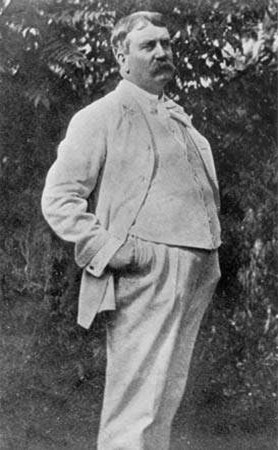
Daniel Burnham (Photo courtesy of the Library of Congress.)
Born in Henderson, New York on September 4, 1846, Daniel Burnham would go on to design some of the greatest works in American history, including Washington, DC’s Union Station. At the age of 8, his family moved to Chicago; however, Burnham attended school in Waltham, Massachusetts. As a young man, he unsuccessfully attempted to get admitted to Harvard and Yale. Afterward, he moved to Chicago and worked under William Le Baron Jenney, an engineer and architect, also known as the “Father of the American Skyscraper”. Burnham later moved to Nevada in hopes of mining silver, but ended up working in the local political court. He ran for the Nevada State Senate, but failed to win a seat. After his political defeat in 1870, Burnham returned to Chicago to work in Peter Wright’s architecture firm where, in 1872, he met John Wellborn Root, his future business partner.
In 1873, they established Burnham and Root, a renowned architecture firm in Chicago, and designed many significant towers, including one of the first American skyscrapers, the Masonic Temple, in 1891. The two also spearheaded the design and construction of the World’s Columbian Exposition (also known as the Chicago World’s Fair) until Root’s unexpected death in 1891. Burnham continued with the project as its Director of Works and, through his leadership and guidance, the Exposition overcame financial and technical challenges within a pressing timeframe. By the time of its opening in 1893, the World’s Columbian Exposition was noted as the world’s largest fair. The Exposition brought Burnham great respect and recognition in the field and many cities began to seek his expertise.
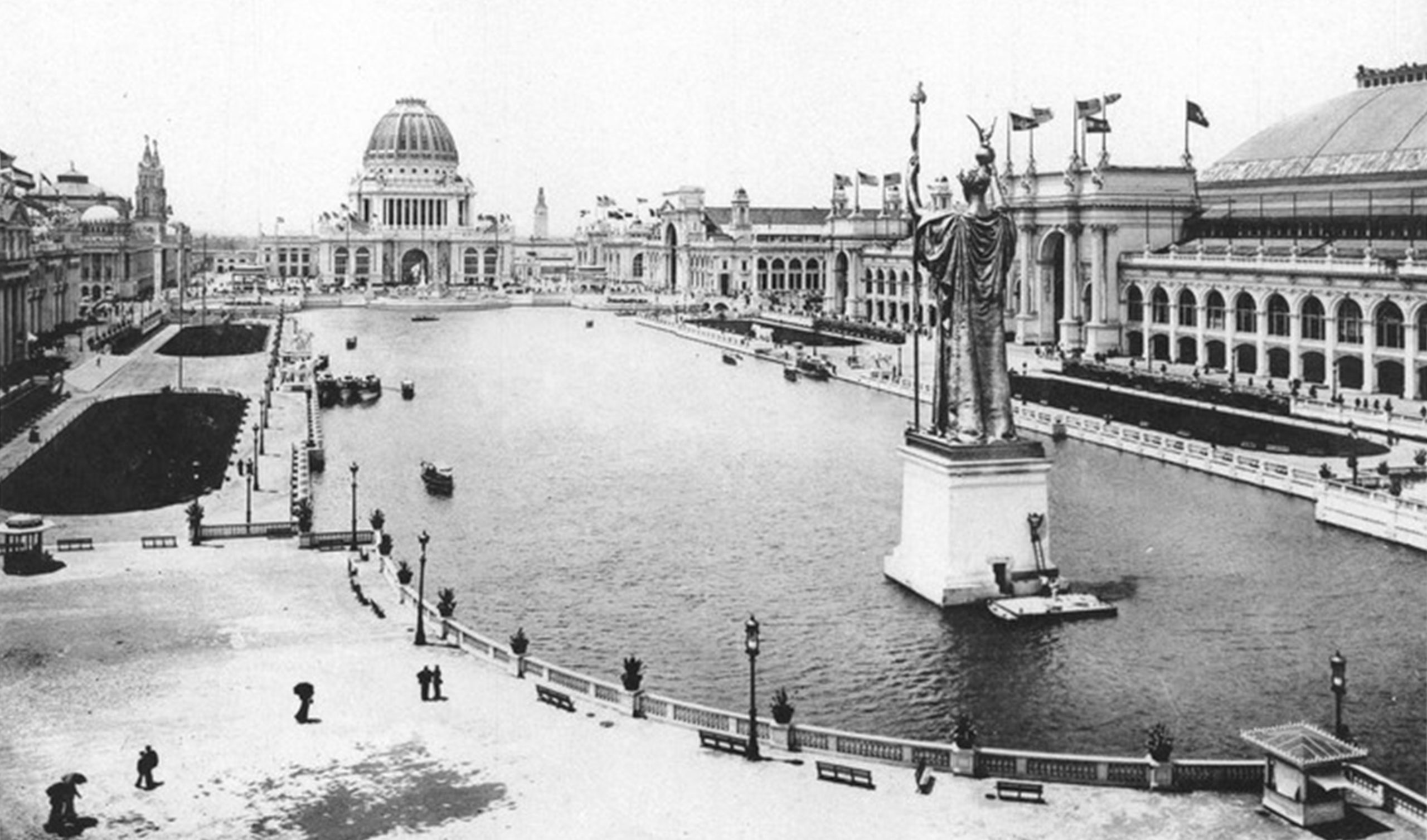
The Great Basin, the Court of Honor, and administrative buildings at the World’s Columbian Exposition. (Smithsonian Magazine, November 20, 2012.)
In 1901, Burnham was appointed to be a member of the U.S. Senate Park Commission, headed by Senator James McMillan of Michigan, which developed the McMillan Plan. Two key components of the McMillan Plan were the National Mall and Union Station. Burnham and his fellow Commission members, many of whom were colleagues from the World’s Columbian Exposition project, extended the National Mall beyond the Washington Monument to the Lincoln Memorial and provided the foundation for the Jefferson Memorial.
Union Station was another, perhaps more complex, part of the plan. The District was in urgent need of a new station that could house the growing capacity of transportation flow that the city was facing. In 1901, the Pennsylvania Railroad and the Baltimore and Ohio Railroad agreed to remove the tracks and terminals from the National Mall and finally build a station that met the aforementioned demands and matched the status of the city as the national capital. However, as with every monumental project, there was political dissent, financial complications, and community opposition. Nonetheless, under the direction and guidance of the U.S. Senate Park Commission and Burnham’s architecture firm, D.H. Burnham & Company, Union Station welcomed its first train in October 1907 and officially opened in 1908.
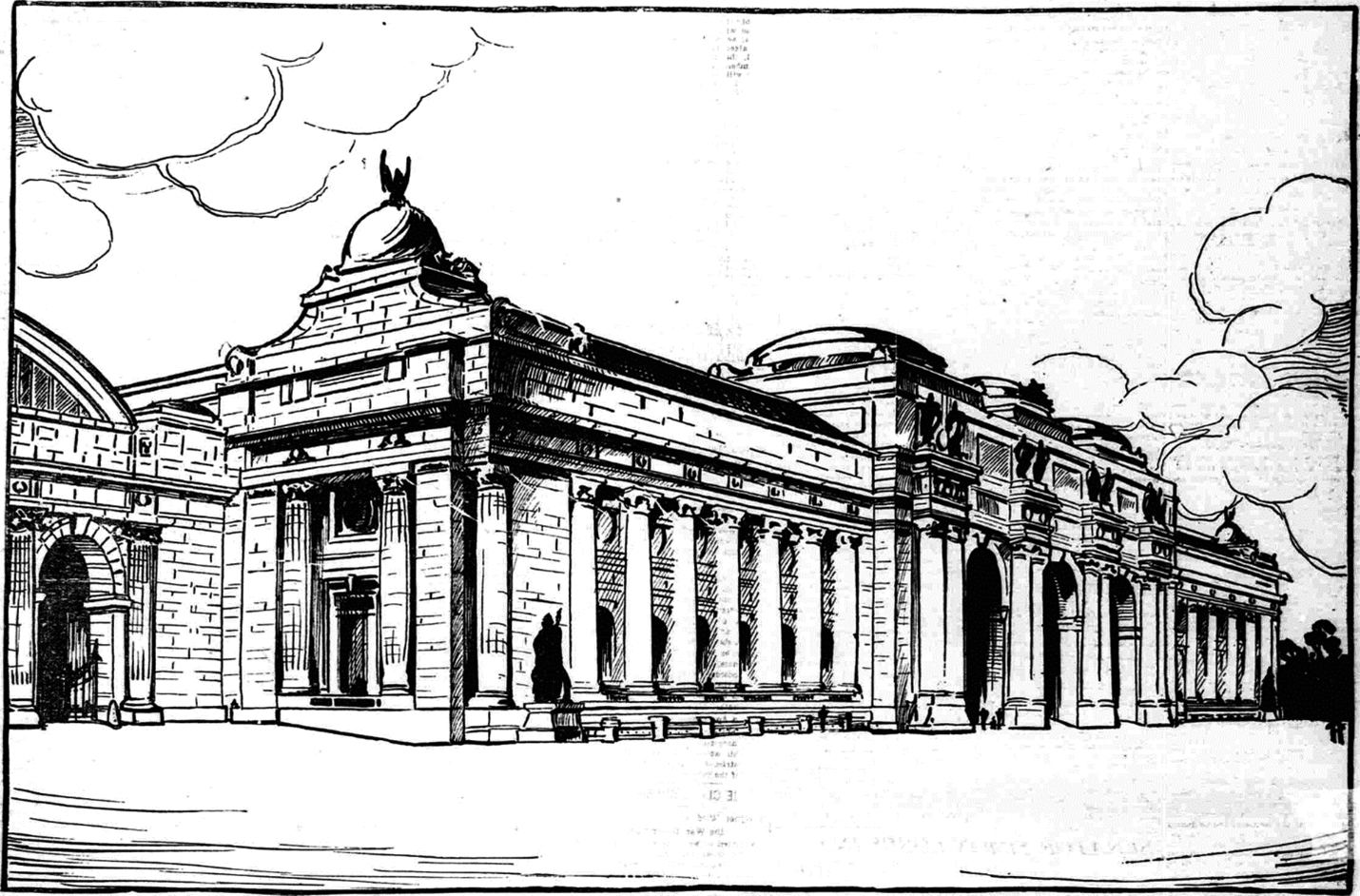
A 1902 design proposal for Union Station. (The Times, Washington, March 17, 1902, courtesy of the Library of Congress.)
As the McMillan Plan steadily came to a conclusion, from 1906 to 1909, Burnham took on The Plan of Chicago with Edward Bennett, an architect and urban planner. This plan was the first controlled growth plan for an American city and included various public spaces such as a lakefront, parks, and a central square consisting of major boulevards, fountains, and administrative buildings. Although the plan was only realized in parts, Burnham established an urban standard that continues to be widely referenced in Chicago. Afterward, Burnham continued to design and construct distinguished structures and landscapes in various cities around the United States and the world.
On June 1, 1912, in Heidelberg, Germany, Burnham’s life came to an end. He left behind his two sons, who followed in his footsteps, a daughter, and his wife Margaret Sherman. He also left an influential legacy that impacts millions of people every day. Many of his ideas, structures, and plans still stand and are in effect today. Burnham’s contribution to urban planning and architecture spanned through many cities beyond Chicago and Washington, DC, such as Cleveland, San Francisco, Pittsburgh, New York, and Manila and Baguio in the Philippines. He shaped many great American and international cities and influenced both the social and physical landscapes and accessibilities of them all.
Sources
• https://www.smithsonianmag.com/arts-culture/where-did-pabst-win-that-blue-ribbon-138975181/
• https://chroniclingamerica.loc.gov/data/batches/dlc_abe_ver01/data/sn87062245/100493007/1902031701/0231.pdf
• https://www.britannica.com/biography/Daniel-Burnham
• https://www.architecture.org/learn/resources/architecture-dictionary/entry/burnham-and-root/
• https://www.nps.gov/nationalmallplan/Documents/Studies/m2.pdf
• https://www.tclf.org/pioneer/dh-burnham-and-company
• http://mallhistory.org/items/show/88